
File 00: Why Most Traders Stay Stuck

Follow every article published on The Trading Files without missing a single update.
👇

6 min documentary • 7 min read
The opening file of The Trading Files — an independent documentary project about the hidden side of the trading journey.
The investigation Begins
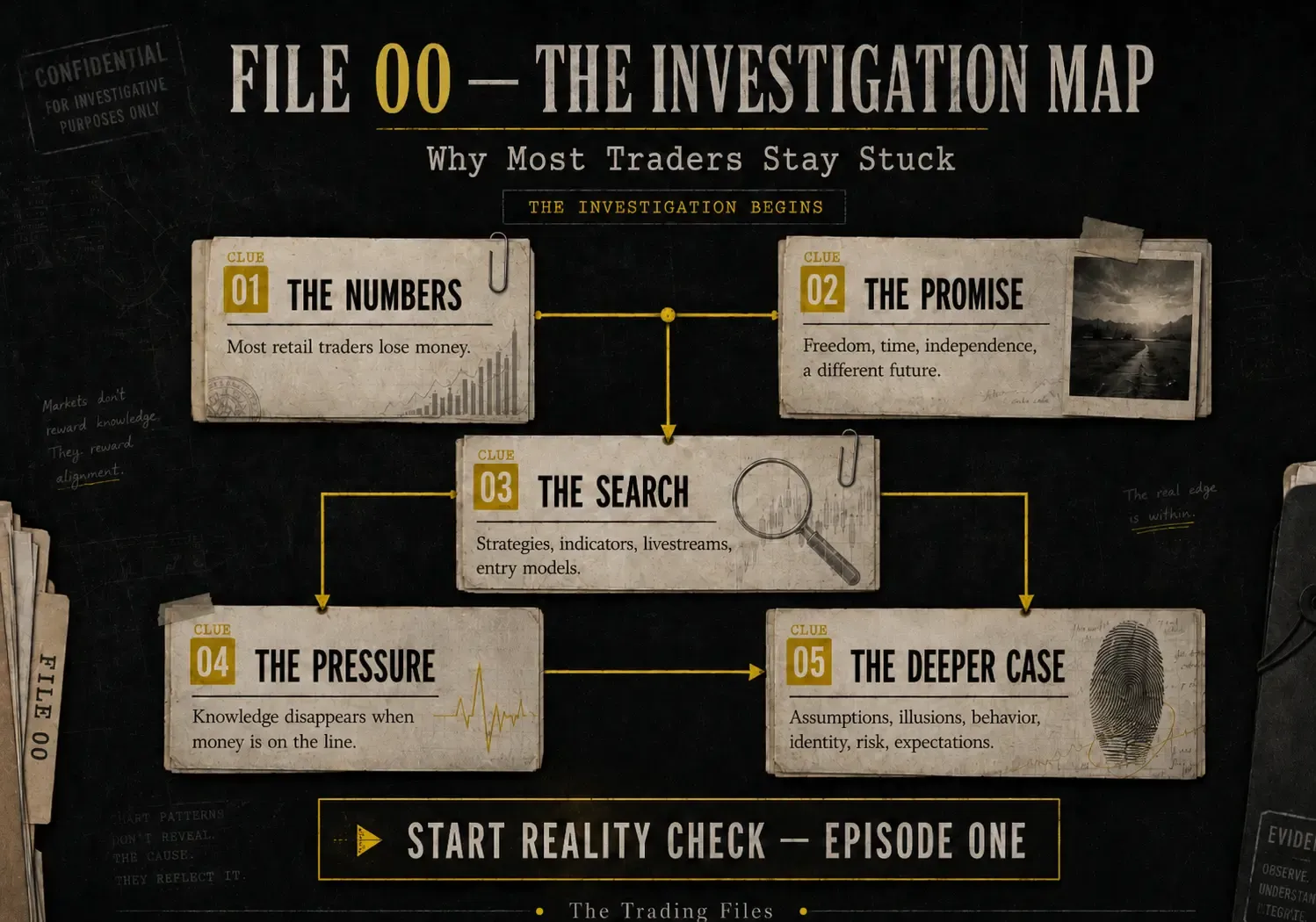
Most traders do not enter the market because they want to lose money.
They enter because trading seems to offer something powerful.
Freedom.
Time.
Independence.
The possibility of building a different future.
And that is exactly why the numbers are so uncomfortable.
Depending on where you look, most retail traders lose money.
The exact percentage changes from broker to broker, market to market, and report to report.
But the message behind those numbers does not change.
Most people who enter this game do not make it through in the way they imagined.
That fact is not hidden.
The warnings are everywhere.
But somehow, people still step in.
They still open accounts.
They still fund challenges.
They still study strategies.
They still watch videos.
They still believe that, with enough time, enough effort, or the right missing piece, they might be one of the exceptions.
And maybe that is not irrational.
Because from the outside, trading looks learnable.
You find a strategy.
You manage your risk.
You stay disciplined.
You repeat the process.
It sounds simple enough to understand.
But simple to understand is not the same as simple to survive.
The Search for the Missing Piece
Most traders begin by looking in the obvious places.
A better strategy.
A cleaner entry model.
A higher win rate.
A new indicator.
A different time frame.
A more profitable setup.
Another livestream where someone makes the process look easy.
And sometimes, for a moment, it works.
You catch a clean trade.
You have a good week.
You follow your plan.
You see a result that makes you think something has finally clicked.
That moment matters.
Because it gives the journey just enough hope to continue.
But then something changes.
The same setup does not work the same way.
The same rule becomes harder to follow.
The same loss feels heavier than expected.
The same confidence that helped you enter the market quietly turns into overtrading.
You keep learning.
But you do not feel more stable.
You understand more concepts.
But you do not feel more in control.
You collect more information.
But somehow, the same patterns keep returning.
And that is where trading becomes confusing.
Because the problem no longer looks like a lack of knowledge.
It starts to feel more personal.
When the Problem Starts to Look Like You
At some point, many traders ask the question they do not really want to ask.
What if I am the problem?
Not the strategy.
Not the market.
Not the broker.
Not the setup.
Not the indicator.
Me.
My discipline.
My mindset.
My emotions.
My patience.
My ability to follow a plan.
And there is some truth there.
Trading does expose the trader.
It exposes impatience.
It exposes fear.
It exposes overconfidence.
It exposes the need to be right.
It exposes the desire to recover quickly.
It exposes the inability to sit with uncertainty.
But stopping there is too easy.
Because if the answer were only “be more disciplined,” more traders would have solved the problem.
If the answer were only “fix your mindset,” more traders would have made it through.
If the answer were only “manage risk better,” more traders would have turned knowledge into consistency.
And if the answer were only “find a better strategy,” the industry would not be full of traders who know plenty of strategies and still cannot execute them under pressure.
These answers matter.
But they are not the whole case.
They are symptoms.
They are visible pieces of a deeper structure.
And most traders never get far enough to investigate that structure properly.
The Moment Trading Changes
Outside the trade, everything can feel clear.
The plan makes sense.
The risk is defined.
The setup is obvious.
The logic is clean.
But once money is on the line, the environment changes.
The screen feels different.
A candle moving against you no longer looks like neutral information.
It feels like a threat.
A small loss no longer feels like part of the business.
It feels like a mistake that needs to be repaired.
A clear rule no longer feels fixed.
It becomes negotiable.
And that is where the real questions begin.
Why do traders keep repeating the same mistakes?
Why does knowledge disappear under pressure?
Why does a clear plan become so fragile in the moment?
How does confidence quietly become overtrading?
How does one loss become five?
And how does something that looked so simple from the outside become so difficult to survive from the inside?
These are not small questions.
They are not solved by another motivational quote.
They are not solved by pretending emotions should disappear.
And they are not solved by reducing the entire trading journey to discipline, mindset, risk management, or strategy.
Because trading is not just a technical activity.
It is a pressure environment.
And pressure changes people.
The Pattern Is Too Common to Ignore
When one trader repeats the same mistake, it may be an individual issue.
When thousands of traders repeat the same patterns for years, across different markets, strategies, accounts, and levels of experience, it becomes something else.
It becomes a case.
The same loops appear again and again.
The trader studies more but executes worse.
The trader knows the rule but breaks it in the moment.
The trader wants freedom but becomes emotionally trapped by every result.
The trader says they accept risk but reacts as if every loss is personal.
The trader believes they are close, then destroys weeks of progress in one decision.
This is why the usual explanations feel incomplete.
They describe what happened.
But they rarely explain why it keeps happening.
They point to the mistake.
But they do not always investigate the structure that produced it.
And that is the gap The Trading Files exists to explore.

What The Trading Files Is
The Trading Files is an independent documentary project about the trading journey.
Not a collection of random trading videos.
Not a place for predictions.
Not a shortcut.
Not a promise of certainty.
Not another polished version of trading that makes the journey look easier than it really is.
The Trading Files exists to investigate what this game actually demands from the person who enters it.
The assumptions traders bring with them.
The illusions they do not know they are carrying.
The emotional patterns they only discover under pressure.
The hidden challenges that usually become visible only after time, losses, frustration, and repeated mistakes.
Because most traders are not only fighting the market.
They are fighting what they believed trading was supposed to be.
They believed progress would feel clearer.
They believed more knowledge would create more control.
They believed a good strategy would make execution easier.
They believed risk management would protect them from themselves.
They believed time in the market would automatically make them better.
And when those beliefs collide with reality, many traders do not know what to do with the gap.
So they keep searching.
More videos.
More systems.
More rules.
More accounts.
More explanations.
But often, they are searching for better answers without asking better questions.
Why This Project Starts With The Numbers
The numbers are not the whole story.
But they are the first clue.
If most retail traders lose money, the question cannot only be why they fail.
There is an earlier question.
Why do so many still step in?
What brought them here?
What did they believe trading would give them?
What version of trading did they imagine before they experienced the real one?
And when someone enters a game where most people struggle to make it through, are they really prepared for what they are about to face?
That is where the investigation begins.
Not with a strategy.
Not with a setup.
Not with a motivational speech about discipline.
But with the gap between what trading seems to offer and what trading actually demands.
Because the dream is not irrelevant.
The dream is part of the case.
Freedom.
Time.
Independence.
A different future.
These ideas are powerful enough to pull people into one of the most difficult performance environments they will ever face.
And unless those ideas are examined, they quietly shape every decision that follows.
The First File
The Trading Files begins with Reality Check.
A series about the lies, assumptions, and uncomfortable truths behind the trading journey.
Each episode opens another layer of the case.
One illusion.
One assumption.
One hidden challenge.
One part of the journey most traders only understand after paying for it.
Sometimes with money.
Sometimes with time.
Sometimes with confidence.
And sometimes with years of frustration they did not know how to interpret.
This project is not here to make trading look impossible.
But it is also not here to make it look easier than it is.
Because if the failure rate is this high, then easy explanations are not enough.
The investigation needs to go deeper.
And the first question is not simply why most traders fail.
The first question is why so many people enter the game believing they are ready for something they have not yet understood.
This is The Trading Files.
One file at a time.

Want to follow every post published on The Trading Files without missing a single update?
👇
Subscribe the Newsletter
Drop your email address and never miss new releases and the latest trading insights.
© 2026 The Trading Files. All rights reserved.